
Roundtable Discussion with Outside Directors
Leveraging Our Core Strengths to Drive the Next Stage of Growth. Perspectives, Challenges and Expectations from Our Five Outside Directors.
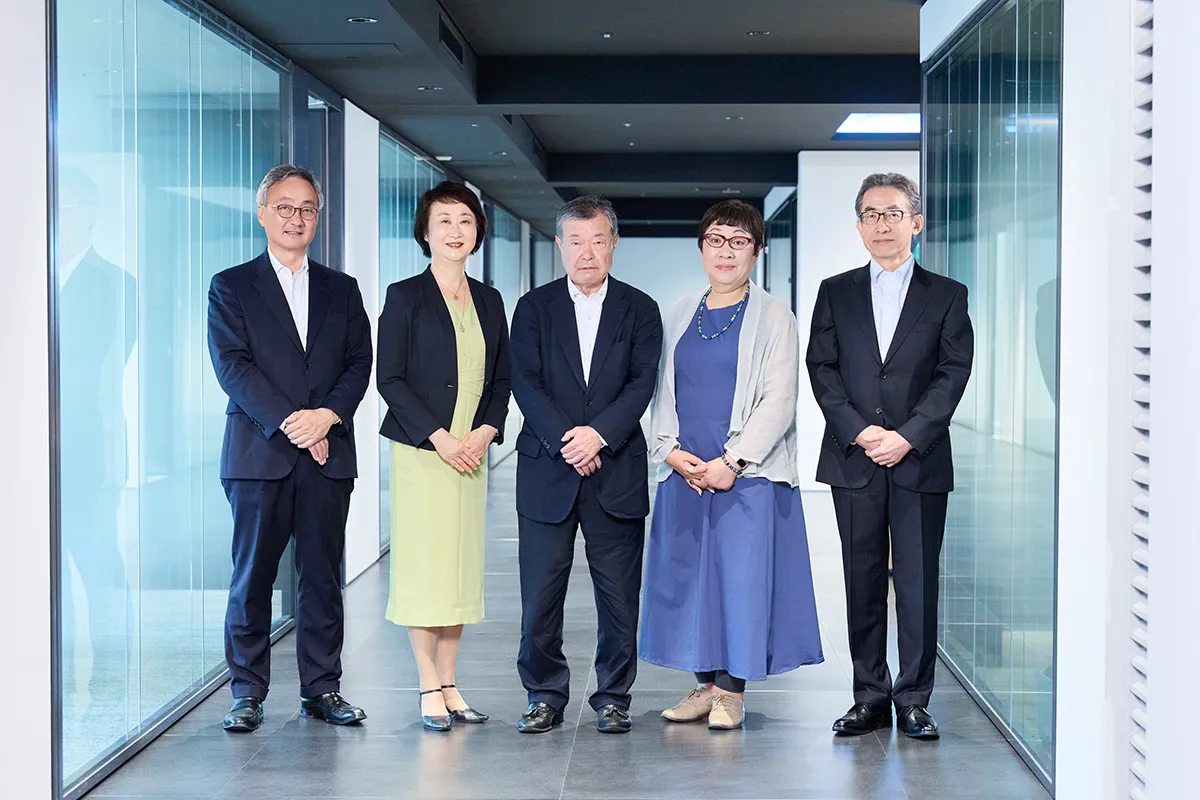
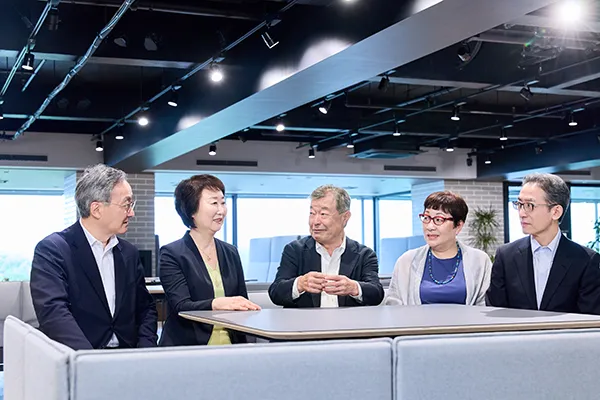
(From the left)
Ken Shibusawa, Outside Director (Independent Officer)
Tami Kihara, Outside Director (Independent Officer)
Etsuhiro Takato, Outside Director (Independent Officer)
Mika Matsuo, Outside Director (Independent Officer)
Yuji Hirako, Outside Director (Independent Officer)
Q1. Effectiveness of the Board of Directors-
Please tell us about your assessment of the effectiveness of the Company’s Board of Directors, and how you plan to utilize your expertise in governance and management going forward.
Shibusawa: I was newly appointed as an Outside Director in FY2025. I commend the Company’s atmosphere in which Outside Directors can speak freely and honestly. In addition to the Board meetings, time is set aside for officer discussions, creating a system in which free exchanges of opinions can be held before matters reach the resolution stage. During the company tour conducted this fiscal year, I was able to directly observe the initiatives of our business partners and the security measures being implemented, which reaffirmed my belief that meticulous efforts are being made even behind the scenes. My role is to look 10 or even 20 years into the future from a long-term investment and global perspective. I provide candid views from an independent perspective.
Matsuo: I highly commend the transparency demonstrated when Outside Directors ask insightful questions and officers responsible for the matters, not limited to the President and Chairman, provide thorough answers. Many different executive officers take turns giving explanations at each meeting, and I genuinely feel that there is a strong sense of commitment throughout the organization. I leverage my expertise as the only person with practical experience in retail banking, and I also actively speak out about the challenges of international business from a global perspective.
Hirako: I see value in not overloading directors with information in advance, as it allows discussions to unfold without predetermined conclusions. At the same time, the depth and quality of those discussions depend heavily on the quality of the information provided beforehand. In order to enhance the effectiveness of the Board of Directors, I ask that “what was discussed, how it was discussed, and what results it led to” be clarified prior to a meeting. I feel that there is a growing need for a process that starts with an overview of the overall strategy rather than one that focuses on the details of individual issues. In addition, since each employee is young and diverse, I believe it is necessary to fully utilize their strengths. Drawing on my management experience, I would like the Board of Directors to have more in-depth discussions on Group-wide human capital management.
Kihara: I agree. We need to shift the discussions at Board meetings from detailed policy-level issues to broader themes such as company strategy. I think it would be effective to share the topics we want to discuss in the current fiscal year before the start of the fiscal year and to allow for preparation time. I would like to oversee the digital and AI/IT fields in particular. The Company was one of the earliest to announce its policy on utilizing generative AI, and it was selected as one of the DX Stocks. However, in response to proactive investments in AI and core systems, a key challenge is to establish clear target figures at the planning stage and ensure that the expected benefits are fully realized. At the same time, I want to fully support efforts that leverage the power of technology to enhance corporate value, without holding them back.
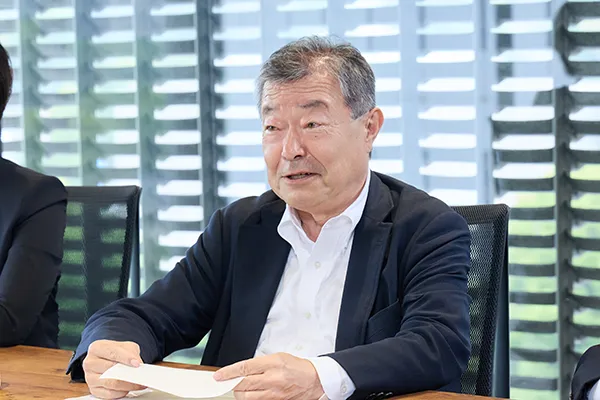
Etsuhiro Takato, Outside Director (Independent Officer)
Takato: I commend the fact that, compared to when I joined the Board four years ago, more time is now being put towards strategic discussions rather than minute operational details, and that discussions have gained more depth. When engaging in strategic discussions, it is crucial to strike a balance between practical issues and the overall picture. I have been involved in organizational management since I was in my 30s, and I have been through numerous business crises and high-stakes management situations. I speak from personal experience about the common decision-making pitfalls that organizations tend to fall into, and the danger of individuals falling into said traps even when they understand them intellectually. I want to contribute to fostering an organizational culture where business unit leaders take personal responsibility for achieving profit targets.
Q2. Capital and business alliance with ITOCHU Corporation-
Following a change in capital structure, ITOCHU Corporation has become a major shareholder in addition to Seven & i. How do you view this change?
Takato: Regarding ITOCHU Corporation, I believe that a capital and business alliance based on an equal relationship, which the Company had been aiming for from the beginning, has been realized in a tangible way through the installation of ATMs in FamilyMart stores. It is only with this major pillar of collaboration in the ATM business that we can move forward with other businesses, and I believe that things have started off very well.
Hirako: With the dissolution of the parent-subsidiary listing structure, and there are now two major shareholders. Our role as Outside Directors is, above all, to protect the interests of minority shareholders. We need to pay even closer attention to conflicts of interest among shareholders. At the General Meeting of Shareholders in June 2026, directors from both companies were appointed. I have high hopes that this will further stimulate discussions on management as they inspire one another.
Matsuo: I am very much looking forward to seeing to what extent the executive team will be inspired and motivated to take on new challenges now that ITOCHU Corporation, a shareholder with a very strong business culture, has joined us. At the same time, I feel a strong sense of responsibility to make sound decisions that benefit minority shareholders.
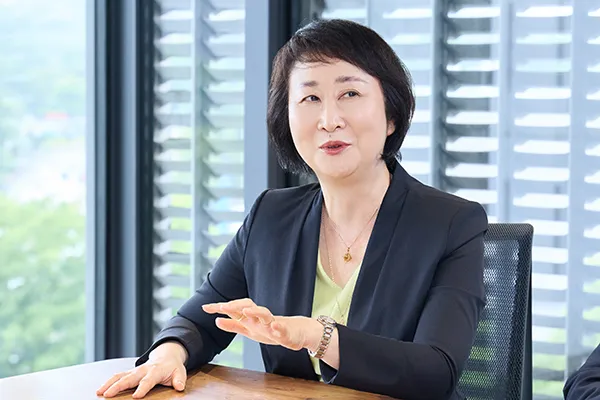
Tami Kihara, Outside Director (Independent Officer)
Kihara: This partnership must contribute to the Company’s future growth by increasing its corporate value. Looking once more at the core concept of “ATM+,” it is described as “a platform that, alongside various business partners, makes future innovation accessible to everyone.”* This time, we have been able to partner with a truly powerful business partner, and I would say that “ATM+” has expanded even further as an infrastructure. Going forward, we need to have in-depth discussions about the synergies that will allow us to convert these opportunities into sustainable earnings and connect to real growth. It is crucial for the Board of Directors to maintain the discipline to translate synergies from qualitative expectations into tangible results.
Shibusawa: I see this as an introduction of “different genes” into a company that has built a 25-year track record in the retail industry. It is crucial to consider how we can revitalize Seven Bank’s value by adding broad global business expertise to front-line retail operations, which are close to consumers. I strongly hope that substantive discussions will take place before resolutions are reached, and that this will ultimately benefit minority shareholders.
- *An Introduction to Seven Bank’s ATMs (in Japanese only)
Q3. Previous Medium-Term Management Plan-Looking back on the previous Medium-
Term Management Plan, which fell short of its targets, what lessons have you drawn and what recommendations would you make from your perspective as an Outside Director?
Takato: With respect to Seven Card Service, which recorded an extraordinary loss in FY2025, my own reflection is whether the Board provided sufficient challenge and scrutiny at earlier stages. Going forward, we need to monitor progress against clearly defined milestones and ensure accountability for results. If progress continues to fall short of expectations, the Board must be prepared to take more decisive action.
Matsuo: The credit card business is inherently challenging for a late entrant. To succeed, we need to move beyond conventional industry practices and develop products and services that reflect the unique strengths of the Seven Bank Group and clearly differentiate us from traditional card issuers. If we cannot make a breakthrough, I believe we are at a stage where we may need to reassess the strategic rationale for continuing the business.
Kihara: In hindsight, we may have moved too quickly into system development before fully defining the business rationale and strategic objectives of the credit card business. A more thorough discussion of those fundamentals at an earlier stage would have strengthened our decision-making. Seven Bank is a unique company that places technology at its core. Now is the time to pause and deepen discussions on IT investment plans that are linked to our business portfolio and management strategy. It is important for all employees to become more aware of which investments are linked to which profits.
Hirako: The Medium-Term Management Plan through FY2025 was heavily target-driven, yet insufficient attention was given to testing the feasibility of those targets. In hindsight, the mechanisms for monitoring progress and challenging performance were not as effective as they needed to be, limiting our ability to make timely course corrections. Looking back, I believe there was more I could have done as an Outside Director. Going forward, I want to increase discussions on what constitutes an optimal business portfolio, based on a shared understanding of whether a strategically important to the Group, taking into account the relationship between investment and profit, and the future potential of the business. I suggest we try incorporating the concept of a risk appetite framework (a framework in which the types and levels of risks acceptable to an organization are defined in advance, and decisions are made within that scope).
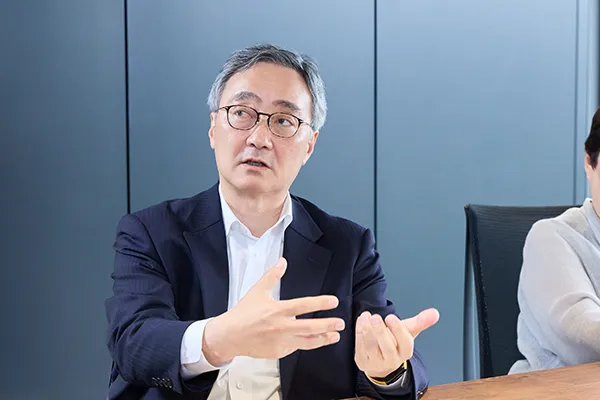
Ken Shibusawa, Outside Director (Independent Officer)
Shibusawa: The primary purpose of a Medium-Term Management Plan is to provide direction, enhance transparency, and align the organization around a shared course of action. However, once targets are disclosed externally, there is a risk that they begin to drive decision-making rather than support it, potentially discouraging bold strategic choices. The banking industry has undergone a dramatic transformation in recent years, entering a world with interest rates. What will be required in the coming era is flexibility in the face of change. Going forward, we should rethink the role of medium-term plans and build an organization that can adapt quickly, respond flexibly to change, and make bold strategic adjustments when circumstances require.
Q4. Future growth potential and the new three-year outlook-
We have set a goal of recovering to a trend of increasing income and profits, but what do you think of our current starting point on this journey? Looking ahead, what do you believe are the key challenges we should address and the areas where we should prioritize investment?
Takato: All four companies in the overseas business achieved profitability in FY2025. In order to eliminate accumulated losses in the future, I hope they will expand their business beyond just deposit and withdrawal transactions. The Company’s largest fixed assets are its ATMs themselves, while its largest intangible assets are human resources, as well as the systems that support ATMs, the network of business partners, and the services that are generated from them. What new things can we do with these assets? I believe that by having all employees should relentlessly focus on creating new value through our ATM platform, and by changing our methods from what has been done before, we will be able to reach a new stage of growth. We need to urgently change our thinking about cost hedging, which we have had little opportunity to consider because we have been living in a world without interest rates for 25 years.
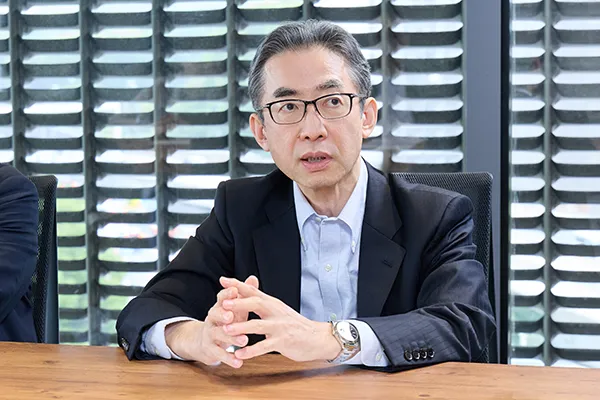
Yuji Hirako, Outside Director (Independent Officer)
Hirako: The Company's top priority should be to sharpen its differentiation. To do that, we must rethink who we compete with and fully recognize the unique value of our ATM network as the interface between the digital and physical worlds. Our greatest asset is not simply our ATMs, but the unparalleled network of locations they provide. The challenge now is to convert that strategic advantage into new sources of growth and profitability. Expansion into FamilyMart stores further increases the number of locations, which carries the risk of cannibalizing Seven-Eleven stores due to overlapping locations. However, if we can add value beyond just cash deposits and withdrawals, having these many locations will become an advantage. Ultimately, one of the most important questions we must answer is how to increase utilization of each ATM. The seriousness with which we tackle that challenge will be a key determinant of our future success. In that sense, I believe a global brand strategy will also be important.
Kihara: No matter how rapidly society moves toward cashless payments, there will always be a need for physical touchpoints that connect people to essential services. As demographic challenges intensify and local governments face growing constraints in delivering services, the social value of our nationwide network will become increasingly important. The expansion of that network through FamilyMart further strengthens our role as a critical piece of social infrastructure. We need to re-evaluate our intangible strengths, such as security technology and operational know-how, and consider how to monetize them. For the next three years, we should dedicate all our energy into making “+Connect” the second pillar of revenue, alongside existing businesses. By leveraging +Connect to strengthen the role of ATMs as social infrastructure and deepen collaboration with diverse stakeholders, we can further establish ourselves as a platform that supports everyday life and unlock entirely new sources of value.
Matsuo: I do not believe we need to be confined by the traditional boundaries of banking. What we need is a mechanism for continuously creating and delivering innovative services that build on the unique strengths of the Seven Bank Group. As President Matsuhashi said, “we want to become a company that people will one day describe as “once a bank” and I look forward to seeing innovations that challenge conventional thinking.
Shibusawa: There is a saying in Japan that the average lifespan of a company is about 30 years. Yet companies that continue creating value beyond that point do so by constantly evolving their businesses to meet the demands of changing times. In that sense, it is not companies that have a 30-year lifespan, but business models. Seven Bank accounts are incredibly convenient once you start using them. However, in the next 30 years, cash might not exist in its current form anymore. While ROE (Return on equity) and sales growth are certainly important, I believe we need to more clearly articulate and demonstrate our non-financial value, including the social role of our security technologies and ATM network, in doing so, foster a shared sense of its importance throughout the organization, will be our starting point for future growth.
Message to stakeholders-Finally, we would like to ask our Outside Directors to give a message to our shareholders, investors, and other stakeholders.
Takato: The discussions we have had today will only matter if they are translated into action. By building on its highly secure business model and the expertise accumulated over the years, Seven Bank has the opportunity to create both social and economic value. I hope management will pursue that mission with determination and accountability, ensuring that the efforts of employees on the front lines are recognized and rewarded.
Kihara: At this year’s Purpose Award, held annually to reinforce our Purpose throughout the organization, I was encouraged to see that half of the presenters were women. Equally inspiring were the many employees working in areas such as financial crime prevention and security who are deeply committed to their responsibilities and driven by a strong sense of purpose. Across the Group, we have a diverse range of talented people who take pride in their work and put our Purpose into practice every day. Our role as management is to harness that diversity as a source of strength and translate it into sustainable organizational performance. I hope stakeholders will continue to follow our progress with high expectations.
Shibusawa: The true strength of Seven Bank lies in the fact that both its ATMs and accounts are deeply embedded in the everyday lives of consumers, making them increasingly indispensable over time. That is why I hope more individual investors will choose to become shareholders and join us in thinking about what the next chapter of Seven Bank should look like. I also hope we can create a governance framework in which the voices of minority shareholders, who represent approximately 40% of our shareholder base, are genuinely heard. Investors are diverse, and so are their expectations. Continuing to engage with them thoughtfully and proactively will be essential in earning their confidence and helping them see the long-term growth potential of Seven Bank.
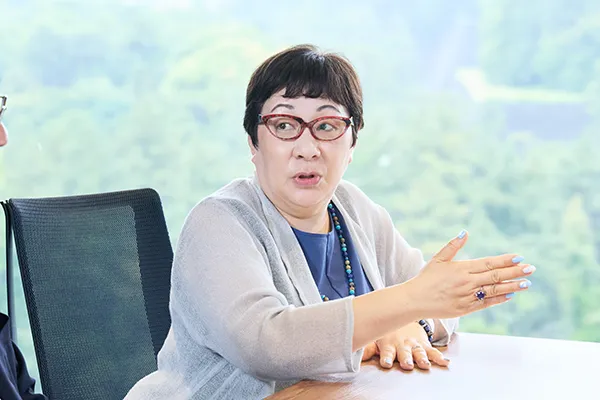
Mika Matsuo, Outside Director (Independent Officer)
Matsuo: Whenever I attend our General Meeting of Shareholders, I can feel how much people care about Seven Bank. I hope we can continue to grow into a company that lives up to those expectations and earns that support. With our ATMs becoming more accessible to FamilyMart customers, the number of people who use and engage with Seven Bank will increase even further. I believe that expansion is highly meaningful, not only because it broadens our customer base, but because it allows us to become a more familiar and indispensable part of people's everyday lives.
Hirako: Seven Bank has built its success on the strength of its ATM network, and I believe the time is now right to take the next step forward. The dissolution of the parent-subsidiary listing structure and the arrival of a new major shareholder mark a pivotal moment in the Company's history, presenting an opportunity that we cannot afford to miss. Our ATM network occupies a unique position as an interface between the digital and physical worlds. By leveraging that strength, we have the potential to create entirely new forms of value and unlock new avenues for growth. I hope our shareholders and stakeholders will continue this journey with us as we shape the future of Seven Bank together. I look forward to your continued confidence and support.
- Management information
- Message from the President
- Management Policy, Management Environment, and Issues to be Addressed,etc.
- Risk Factors
- Risk Management Initiatives
- Compliance Initiatives
- Stock and bond information
- Stock Information
- Dividends and Shareholders Returns Policy
- Corporate Bond and Rating Information
- General Meeting of Shareholders
- IR Library
- IR News
- Financial Statements
- IR Presentations
- IR Calendar
- Annual report
- Seven Bank Disclosure Policy
- Other Corporate Information
- Company
- Sustainability