
Risk Management Initiatives
The purpose of Seven Bank’s risk management is to ensure healthy and effi cient management as aiming at an improvement in corporate value by appropriately managing various kinds of risks related to management.
Risk Management System
Every fiscal year, the Board of Directors establishes the “Basic Policy on Risk Control,” which specifies the overall risk management policy, specific risk management policies and the organization and system for risk management. In accordance with this policy, the Executive Committee establishes detailed rules and regulations related to risk management and confirms the companywide risk status every quarter. The Bank’s risk management structure includes the Risk Management Division, which is responsible for supervising overall risk management activities, specific risk management divisions and the Internal Audit Division to perform internal audits. We have also established the Risk Management Committee and the Security Committee, chaired by the officer in charge of the Risk Management Division, and the Asset-Liability Management (ALM) Committee, chaired by the officer in charge of the Planning Division, as advisory bodies to the Executive Committee concerning risk management. The Group companies also establish risk management system aligned with the Bank’s policy and confirm their risk status, including their specific risks.

Overall Management of Risk
The Bank observes its basic policies relating to overall risk management, which are governed by the Basic Policy on Risk Control and Overall Risk Management Rules, established under the policy. We gain an overall grasp of our risks including climate change by assessing each of the Bank’s risk categories and manage them by comparing them with our equity.
We are also striving for enhanced risk management through priority items for risk management set by the Board of Directors (information security risk, system risk, financial crime countermeasures, market risk and liquidity risk) based on our policy for establishing the risk management structure. Our policy for establishing the risk management structure is based on the ideas of a risk-based approach, principles-based approach, strengthening of risk ownership, and group-based approach.
| Risk type | Risk management |
|---|---|
| Credit Risk | Currently, our risk management activities relating to credit risk are limited to the ATM settlement business, the ALM of interbank deposits placed with top-rated partner financial institutions, bonds, the lending of funds in the call-money market, temporary ATM payment amounts due, and small personal loans, to minimize credit risk. In addition, the Bank performs self-assessment of asset quality as appropriate and establishes an allowance for credit losses in accordance with its self-assessment and reserve rules. |
| Market Risk | It is stipulated that the limits on the maximum level of funds at risk, the market position limits and the loss allowance limits, shall be set. The Risk Management Division measures and monitors market risk in light of these limits and reports the results to management, including the Executive Committee. At the ALM Committee meeting held every quarter, the Bank’s market risk position, expected trends in interest rates and other matters are reported and the policy for the ALM operation is determined. |
| Liquidity Risk | It is stipulated that the limits regarding the cash gaps arising from differences between the period of the management of invested funds and the timing of the liquidation shall be set. The Risk Management Division measures and monitors liquidity risk in light of these limits and reports the results to management, including the Executive Committee. To prepare for emergency events requiring immediate funding, the Bank has devised preemptive comprehensive countermeasures to be able to take quick and flexible Companywide action by risk scenario, and therefore does not expect to experience a major liquidity problem. |
| Operational Risk | Recognizing that operational risks may come to the surface in all business divisions, the Bank has established the structure to identify, evaluate, monitor, control, and reduce risks. Risk categories are as follows.
|
| Priority items | Latest initiatives |
|---|---|
| Information Security Risk |
|
| Systems Risk |
|
| Measures against financial crimes |
|
| Market risk / Liquidity risk |
|
Initiatives for Enhancing Cyber Security
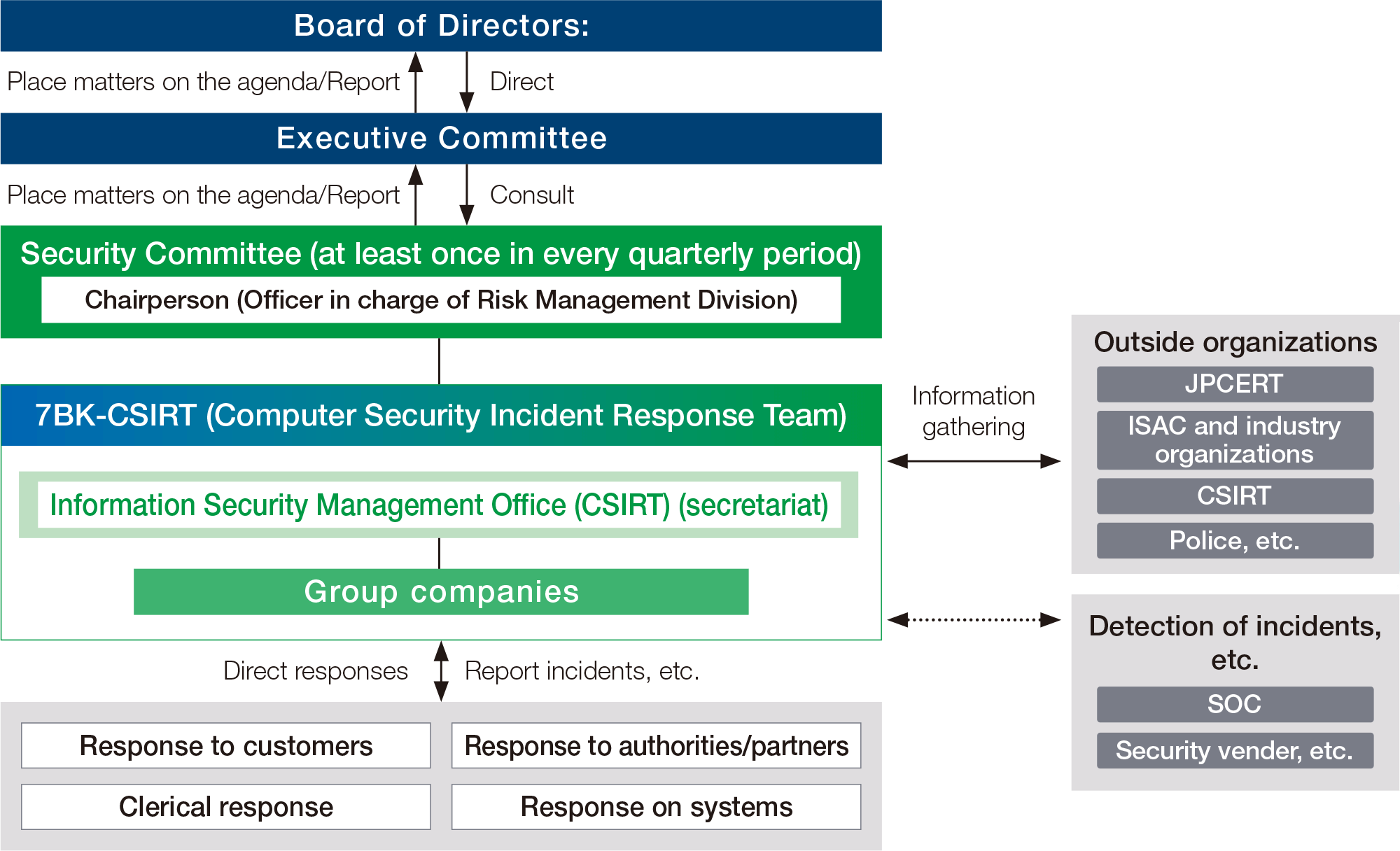
7BK-CSIRT (Computer Security Incident response Team), a dedicated team for cyber security management of the Seven Bank Group, is in charge of the Bankwide management of cyber security risks and is composed of members from multiple divisions. The team responds to a wide range of attacks on the Bank’s services and systems, including cyber attacks, skimming, fake cards, fraudulent access, and information leakage.
7BK-CSIRT conducts training and drills to be able to immediately respond in case of cyber incidents, by taking actions such as information coordination and external response. The initiatives of the team include cooperation with industry organizations and promotion of activities in the security community.
7BK-CSIRT also engages in Security by Design in which security methodology is incorporated as an essential factor at the planning stage of new services, considering increasingly sophisticated cyber attacks and proactive promotion of new technologies. This enables the Seven Bank to provide safe and secure services. Not only 7BK-CSIRT members but also our employees in charge of planning and designing services who are involved Security by Design deepen their knowledge through seminars about preventative measures against fraudulent use of services and other learning opportunities.
Believing the balanced combination of human resources, mechanism, and technology is necessary to maintain security, the Bank is working on each of them.
- Human resources:
- Create security-conscious corporate culture, develop personnel for security, conduct training and drills
- Mechanism:
- Improve rules/procedures on which governance is based, practice Security by Design
- Technology:
- Respond to results of the Bank-wide security diagnosis
Cyber Security Structure
Establishment of Business Continuity Plan (BCP)
To fulfill our social responsibility as a bank, Seven Bank has defined the following four operations as top priorities for continuity in the event of a disaster, large-scale accident, or other crisis: the ATM services; the fund settlement operations serving banks and ATM partners; withdrawals from the Bank’s accounts and money transfer operations; and other operations of which interruption would have a significant impact on our management. Each division has also created a Business Continuity Plan (BCP) to enable continuity of these essential operations in the event of an accident, disaster, or other crisis. In addition, in order to verify the effectiveness of the business continuity management system and the business continuity plan, company-wide initial response drills assuming a major disaster, and drills assuming damage to data centers and other facilities are regularly conducted by departments in charge.
- Management information
- Message from the President
- Management Policy, Management Environment, and Issues to be Addressed,etc.
- Risk Factors
- Risk Management Initiatives
- Compliance Initiatives
- Stock and bond information
- Stock Information
- Dividends and Shareholders Returns Policy
- Corporate Bond and Rating Information
- General Meeting of Shareholders
- IR Library
- IR News
- Financial Statements
- IR Presentations
- IR Calendar
- Annual report
- Seven Bank Disclosure Policy
- Other Corporate Information
- Company
- Sustainability