

- Basic Views
- Evaluation of effectiveness of the Board of Directors
- About Outside Officers
- Policy on Compensation of officers and Compensation System for officers
- Internal Audit and Audit by Audit & Supervisory Board Members
- Status of Improvement and Operation of the Internal Control Systems
- Protection of Rights of Minority Shareholders
Basic Views
Corporate Governance
As a bank that owns and operates an ATM network that manages deposits from a large number of customers and has a nature similar to that of public infrastructure, the Bank recognizes that ensuring disciplined corporate management is vital in responding to social trust and seeks to ensure effective corporate governance. This is achieved by maintaining and improving corporate governance and compliance systems to ensure transparent, fair and swift managerial decision making; clarifying the roles and responsibilities of executives and employees; strengthening management oversight functions; and ensuring equitable operations. The Bank adopts the organizational form of a Company with Audit & Supervisory Board. At the Board of Directors, the Bank ensures effective corporate governance through decision making by Directors with executive authority over operations who are well versed in the Bank’s operations and Outside Directors who have considerable experience and insight in their areas of expertise as well as through audits by the Audit & Supervisory Board Members.
■ Corporate Governance Guidelines
In order to put the Basic Policy on Corporate Governance into practice, we have established the Corporate Governance Guidelines to clarify what we should do specifically and to fulfill our accountability to shareholders.
■ Corporate Governance Report
We submit a Report on Corporate Governance describing our corporate governance system to the Tokyo Stock Exchange and post it on our website.
Corporate Governance System Overview
■ Independence of Officers

■ Main Items and Descriptions

■ Corporate Governance Structure

- ①Board of Directors
-
Number of Meetings held during FY202414times
Average attendance rate99.1%
The Bank’s Board of Directors has consisted of eight Directors, including five Independent Outside Directors. The Board of Directors meets, in principle, once a month to decide the Bank’s basic management policies and important operational issues and to supervise the execution of duties by Directors with executive authority over operations and Executive Officers.
- Major agendas
-
- ・Management policies and plans to achieve the Medium-Term Management Plan
- ・Growth strategy for the credit card business
- ・Capital policy based on the deconsolidation policy of the parent company
- ・Revision of Seven Bank Group’s material issues
- ・M&A
- ・Founding of a new company in Malaysia
- ②Nomination & Compensation Committee
-
Number of Meetings held during FY20248times
Average attendance rate100%
As an advisory body to the Board of Directors, the Bank has established the Nomination & Compensation Committee, chaired by an Independent Outside Director in order to supplement functions of the Board of Directors. The committee is delegated by the Board of Directors to recommend candidates for Director to be put on the agenda at a General Meeting of Shareholders, to recommend candidates for Executive Officer to be put on the agenda at a Board of Directors meeting, and to supervise a plan on successors to the position of Director, etc.
- ③Audit & Supervisory Board
-
Number of Meetings held during FY202414times
Average attendance rate96.4%
The Bank’s Audit & Supervisory Board has consisted of four Audit & Supervisory Board Members, including two Independent Outside Audit &Supervisory Board Members. The Audit & Supervisory Board meets, in principle, at least once a month to receive reports regarding important auditing-related issues and deliberate and make decisions thereof. The Audit & Supervisory Board convenes with Representative Directors, the Internal Audit Division and the Accounting Auditor on a regular basis to exchange opinions and make requests as necessary on issues to be addressed by the Bank, the status of improvements to the Audit & Supervisory Board Members’ auditing environment and important auditing-related issues.
- ④Executive Committee
-
Number of Meetings held during FY202470times
In principle, the Executive Committee meets on a weekly basis to deliberate the execution of important operations, including business plans; acquisition and disposal of assets; credit provision-related issues; borrowing of money and payment of expenses; credit management issues; rewards and sanctions for employees; issues related to employees’ working conditions and benefits; the establishment, change and abolition of the organization; and the formation, revision and elimination of rules and regulations, in addition to conferring on issues to be deliberated at the Board of Directors meetings in advance. The Bank has adopted an executive officer system, and the Executive Committee comprises Executive Officers and others nominated by the Board of Directors.
Evaluation of effectiveness of the Board of Directors
The Bank has conducted “evaluation of effectiveness of the Board of Directors” since FY2015 to improve the effectiveness of the Board of Directors as a forum for strategic and constructive discussions within the Seven Bank Group. In FY2024 as well, a questionnaire survey was anonymously conducted for Directors and Audit & Supervisory Board Members about the operation of the Board of Directors, the composition of the Board of Directors, agenda items of the Board of Directors and other items. The results were deliberated at the Board of Directors.
Results of the evaluation for FY2024
It has been confirmed that the Bank’s Board of Directors has been fulfilling both its decision-making and supervisory functions as all Directors and Audit & Supervisory Board Members share its roles, responsibilities and issues for improvement, and conduct deliberations from diverse perspectives through free and open discussions based on the members’ respective knowledge and expertise. Thus, according to the results of the evaluation, the Board of Directors has been operating appropriately, thereby ensuring its effectiveness.
| Priority Matters for FY2024 | Details of initiatives |
|---|---|
| Advance governance in the Seven Bank Group |
|
| Enhance broad and strategic discussion |
|
| Ensure continuity of opportunities for exchange of views and interaction with executive personnel |
|
Issues for improvement were also identified, which included the diversity of members of the Board of Directors, the appointment and dismissal of senior management, and the need to enhance discussions on internal control and risk management systems. We will continue to work for improvements.
Priority matters for FY2025
-
①
Advance governance in the Seven Bank Group
- ・Improve monitoring functions and enhance discussions from a risk point of view
- ・Increase diversity of the board member composition and the management team, and ensure transparency of appointment and dismissal processes
-
②
Enhance broad and strategic discussion
- ・Share awareness of issues from medium - to long-term perspectives among Board members and have discussions on growth strategies
- ・Share the status of dialogues with shareholders and investors among Board members and have strategic discussions in light of the voices of the capital market
-
③
Ensure opportunities for exchange of views and interaction with executive personnel
- ・Provide opportunities for briefing on operations and information sharing by executive personnel, and organize opportunities for exchange of views and interaction with executive personnel
About Outside Officers
Independence Standards for Outside officers
The Bank’s Independence Standards for Outside Officers are as follows.
- (1)Is not a person with executive authority over operations of the Bank’s parent company or fellow subsidiary (or has been in such position in the past; hereinafter, the same applies to each item);
- (2)Is not a person for which the Bank is a major business partner or a person with executive authority over such entity’s operations, or a major business partner of the Bank or a person with executive authority over such entity’s operations;
- (3)Is not a consultant, an accounting professional, a legal professional or a person belonging to an organization that receives a significant amount of monetary compensation from the Bank, other than officers’ compensation;
- (4)Is not a major shareholder of the Bank or a person with executive authority over operations of such shareholder; or
- (5)Is not a close relative of a person that falls under any of the above or a relative by blood or marriage within the second degree to a person with executive authority over operations of the Bank.
Other matters concerning Independent Officers
The Bank registers all persons who fulfill the qualifications of Independent Officers, as well as the Independence Standards for Outside Officers, as Independent Officers.
Reasons for Appointment of Outside Officers
| Name | Reasons for Appointment | |
|---|---|---|
| Outside Directors | Etsuhiro Takato | Mr. Etsuhiro Takato’s experience and insight in corporate management, marketing, and global duties at Ajinomoto Co., Inc. have genuinely contributed to the Bank’s management. |
| Yuji Hirako | Mr. Yuji Hirako’s experience and insight in corporate management at ANA HOLDINGS INC., etc. have genuinely contributed to the Bank’s management. | |
| Tami Kihara | Ms. Tami Kihara’s experience and insight in corporate management at Ricoh IT Solutions Co., Ltd. and human resource strategy at Ricoh Company, Ltd. have genuinely contributed to the Bank’s management. | |
| Ken Shibusawa | Mr. Ken Shibusawa possesses experience and demonstrated insight in corporate management from a global perspective, including establishment of Shibusawa and Company, Inc. after obtaining an MBA in the United States. | |
| Mika Matsuo | Ms. Mika Matsuo has been involved in corporate management at AIG Japan Holdings KK etc., and possesses experience and demonstrated insight in the area of human resources from a global perspective after obtaining an MBA in the United States. | |
| Outside Audit & Supervisory Board Members | Chieko Ogawa | Ms. Chieko Ogawa’s international insight nurtured in her career as a Certified Public Accountant has genuinely contributed to audits of the Bank’s management. |
| Ichiro Ashihara | We can expect Mr. Ichiro Ashihara to utilize international insight as an Attorney-at-law in auditing our management. | |
Support Systems/Training Policies for Outside Officer
- 1.Provide necessary and sufficient internal systems for enabling Directors and Audit & Supervisory Board Members to fulfill their roles and responsibilities in an effective manner.
- 2.Provide Directors and Audit & Supervisory Board Members with necessary opportunities to enable them to fulfill their roles, such as by providing the information and knowledge relating to the business activities that would be necessary to supervise corporate management when they take office and continually thereafter.
- 3.Build systems for sharing a sufficient amount of the Bank’s internal information with Outside Directors and Outside Audit & Supervisory Board Members (hereinafter referred to as “Outside Officers”).
- 4.Encourage Outside Officers to deepen their understanding of the Bank’s management ethos and corporate culture, while providing information on the Bank’s business environment and other issues on a continuous basis.
- 5.Maintain and improve the environment for Outside Officers to mutually share information and exchange ideas, such as by holding periodic meetings with Executive Officers and/or other Non-Executive Officers.
- 6.Bear the expenses for Outside Officers to fulfill their roles.
Roles and expertise of Directors and Audit & Supervisory Board Members
We believe that the role of Directors and Audit & Supervisory Board Members is to realize appropriate business management by supervising and auditing business execution while fully understanding the social responsibilities and mission of the banking business. In order to properly fulfill this role, we utilize the skill matrix when appointing Directors and Audit & Supervisory Board Members, and aim for a well-balanced composition of members with diverse skills and expertise.
| Skill Type | Definition (Judged by the Nomination & Compensation Committee in a comprehensive manner based on the following principles.) |
Etsuhiro Takato |
Yuji Hirako |
Tami Kihara |
Ken Shibusawa |
Mika Matsuo |
Tsuyoshi Kobayashi |
Yasuaki Funatake |
Masaaki Matsuhashi |
Chieko Ogawa |
Ichiro Ashihara |
Kazuhiko Ishiguro |
Keisuke Aoyama |
|---|---|---|---|---|---|---|---|---|---|---|---|---|---|
| Corporate Management | Skills to perform supervisory functions for the management of the Bank by leveraging experience in managing operating companies, etc., particularly as a top executive. | ● | ● | ● | ● | ● | ● | ||||||
| Sales and Marketing | Skills to provide advice to help the Bank continue to grow through business strategies, by leveraging experience in formulating strategies in the areas of sales and marketing at operating companies, etc. | ● | ● | ● | |||||||||
| Product Development & IT | Skills to provide advice to help the Bank continue to create new services, by leveraging experience in formulating strategies in the areas of product development and IT at operating companies, etc. | ● | ● | ● | |||||||||
| Global | Skills to provide advice to help the Bank grow its overseas business, leveraging international experience and knowledge | ● | ● | ● | ● | ● | ● | ● | ● | ||||
| Human Resources & Labor | Skills to provide advice to help the Bank promote human resource strategies that are linked with management strategies, leveraging experience and knowledge in human resources | ● | ● | ● | ● | ||||||||
| Financial Affairs and Finance | Skills to provide advice to help the Bank promote financial strategies, leveraging experience and knowledge in financial affairs and finances at operating companies mainly in the banking industry | ● | ● | ● | ● | ● | ● | ||||||
| Legal Affairs & Risk Management | Skills to provide advice to help the Bank manage risk, leveraging experience and knowledge in legal affairs at operating companies mainly in the banking industry | ● | ● |
Policy on Compensation of officers and Compensation System for officers
Seven Bank’s “Policy on Compensation of Officers and Compensation System for Officers” were, excluding compensation for Audit & Supervisory Board Members, proposed to the Board of Directors by the Nomination & Compensation Committee, and determined with a resolution of the Board of Directors as follows:
1 Basic Policy on Compensation of Officers
The Bank decides compensation of officers based on the following points.
- (1)Ensuring a compensation system to promote sustainable improvement of corporate value with emphasis placed on the link to business performance
- (2)Ensuring compensation systems and compensation levels with their responsibilities to secure highly capable human resources who lead and take responsibility for, in an appropriate manner, the supervision and execution of operations
- (3)Ensuring a compensation system based on an objective and transparent process, and that is fair and equitable
2 Method for Determining Compensation, etc. for Individual Officers in the Fiscal Year under Review
The Bank has established a Nomination & Compensation Committee, comprising a total of five members made up of three Independent Outside Directors and two Representative Directors, chaired by an Independent Outside Director, as an advisory body to the Board of Directors (as of the end of the fiscal year under review)*. The Nomination & Compensation Committee proposes specific amounts of compensation, etc. to be granted to Directors within the range of the total amount approved at the General Meeting of Shareholders, for determination by resolution of the Board of Directors. From the perspective of understanding the process of discussion, Audit & Supervisory Board Members may participate as observers who do not possess voting rights, when a Nomination & Compensation Committee meeting is held. The procedure is stipulated in the Regulations for Officers, which is modified, amended, or abolished by a resolution of the Board of Directors upon discussion with
the Audit & Supervisory Board Members.
Compensation, etc. for Audit & Supervisory Board Members is determined upon discussion by the Audit & Supervisory Board Members within the range of the total amount approved at the General Meeting of Shareholders.
- ※The Nomination & Compensation Committee consists of a total of seven members: five Independent Outside Directors and two Representative Directors as of July 1, 2025.
3 Compensation Structure
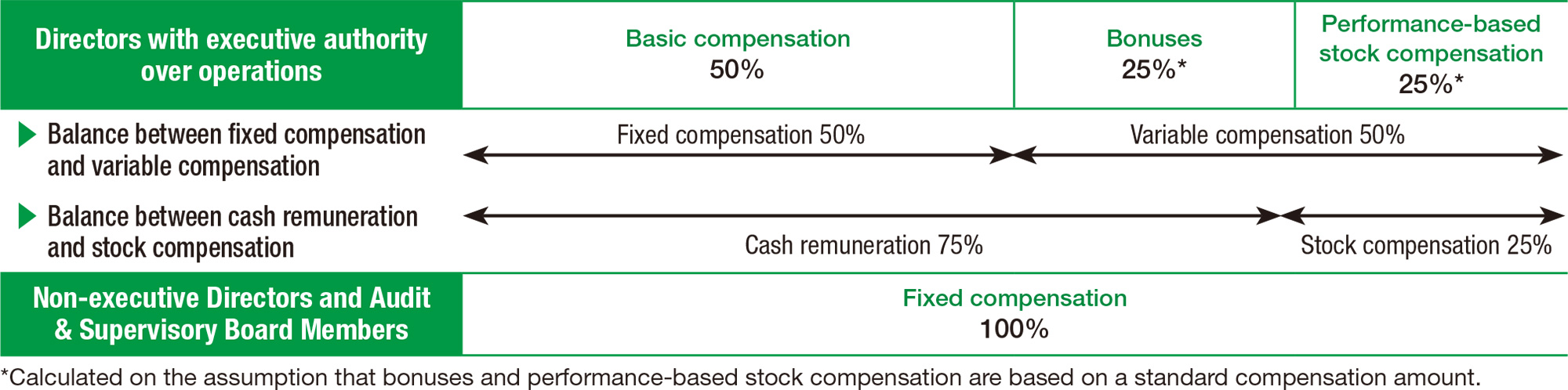
The Bank’s compensation structure for officers comprises “basic compensation” as fixed compensation and “bonuses” and “performance-based stock compensation” as variable compensation, which are applied as follows.
| Fixed compensation | Variable compensation | ||
|---|---|---|---|
| (a)Basic compensation | (b)Bonuses | (C)Performance-based stock compensation | |
| Directors with executive autlority over operations | ● | ● | ● |
| Non-executive Directors | ● | ー | ー |
| Audit & Supervisory Board Members | ● | ー | ー |
Each plan is positioned as follows.
| (a)Basic compensation | Compensation aiming to encourage steady execution of duties commensurate with job rank |
|---|---|
| (b)Bonuses | Short-term incentives aiming to steadily achieve performance targets (milestones) for each fiscal year for the medium-to long-term improvement of corporate value |
| (C)Performance-based stock compensation | Medium-to long-term incentives for the medium-to long-term improvement of corporate value, aligning interests with shareholders |
The ratio of each plan has been decided as described below by a resolution of the Board of Directors upon a proposal by the Nomination & Compensation Committee. Factors taken into account included a balance between fixed compensation and variable compensation, a balance between cash remuneration and stock compensation, and a balance between bonuses and stock compensation, which are incentives to execute management with a well-balanced perspective in both the short-term and the medium- to long-term (excluding compensation for Audit & Supervisory Board Members).
In addition, non-executive Directors and Audit & Supervisory Board Members receive only fixed compensation, as their role is to supervise the Bank’s management from an objective and independent standpoint.
4 Compensation Level
To provide a competitive compensation level and thereby secure highly capable human resources, the Bank’s compensation level for officers has been determined by a resolution of the Board of Directors based on the proposal made by the Nomination & Compensation Committee. The deliberation was based on the analysis and comparison of data on the compensation levels of a group of companies of the same size and operating in the same industry as the Bank, which has been drawn from a larger body of objective data on compensation levels provided by an outside professional organization (excluding compensation for Audit & Supervisory Board Members).
5 Details and Method of Calculation of Variable Compensation
- ・Bonuses
- Bonuses, which are provided as short-term incentives, will be determined by multiplying the standard amount of compensation for each job rank by performance-linked factors corresponding to the achievement of consolidated performance targets for the previous fiscal year.
- ・Performance-based stock compensation
- Performance-based stock compensation, which is provided as a medium- to long-term incentive, is composed of a “fixed portion,” which grants fixed points for each job rank, and a “performance-based portion,” which grants a varying number of points determined by job rank and performance. For each portion, points are granted and accumulate every year of the term of office of the relevant officer, and a number of the Bank’s shares corresponding to the amount of accumulated points will be delivered to the officer upon retirement.
The number of points (i.e., the number of shares to be delivered) to be provided in the performance-based portion will be determined by multiplying the number of points for each rank by performance-linked factors according to the achievement level of consolidated performance targets.
The Bank has introduced a clawback clause that allows the Bank to require Directors to repay performance-based stock compensation in the event of falling under certain circumstances such as gross negligence or fraud in relation to financial results, material revision of financial results, or violation of law or regulation as well as the malus clause. Compensation that may be subject to repayment is performance-based stock compensation received as compensation for the fiscal year in which the relevant circumstances arose and the three preceding fiscal years. This provision applies to performance-based stock compensation granted as compensation for the fiscal year ended March 31, 2024 and all periods thereafter. - ・Evaluation indicators for variable compensation (performance indicators) and evaluation method
- Consolidated ordinary income and consolidated ordinary profit are used as the evaluation indicators to take account of both sales size and profitability aspects with a good balance. Additionally, employee engagement was added as an evaluation indicator to be reflected by the performance-based stock compensation points granted for the fiscal year ended March 31, 2024 and thereafter.
| Plan | Indicators and evaluation method | |
|---|---|---|
| Bonuses |
|
|
| Performance- based stock compensation | Fixed portion | ー |
| Performance- based portion |
|
|
Targets and Results of Evaluation Indicators for Variable Compensation
For the performance-based portion of bonuses and performance-based stock compensation, the degree of target achievement is used as an evaluation indicator. For this purpose, the performance forecasts for the fiscal year ended March 31, 2025, including consolidated ordinary income and consolidated ordinary profit, disclosed with the announcement of the financial results for the previous fiscal year (on May 10, 2024) are used as target figures.
Fiscal year under review (from April 1, 2024 to March 31, 2025)
| Evaluation indicators | Target (Millions of yen) | Result (Millions of yen) | Degree of target achievement (%) |
|---|---|---|---|
| Consolidated ordinary income | 215,000 | 214,408 | 99.7% |
| Consolidated ordinary profit | 28,000 | 30,289 | 108.2% |
| Evaluation indicators | Score in March 2024 | Score in March 2025 | Year on Year |
|---|---|---|---|
| Employee engagement | 69 | 71 | +2 |
- ※Of the evaluation indicators, those for employee engagement are expressed as an index representing the results comparing the total scores for the employee engagement survey conducted in March 2024 and March 2025.
Internal Audit and Audit by Audit & Supervisory Board Members
① Cooperation between Audit & Supervisory Board Members and the Accounting Auditor
Audit & Supervisory Board Members and the Accounting Auditor hold regular meetings to exchange opinions and promote mutual cooperation, based on the audit contract with KPMG AZSA LLC. Audit & Supervisory Board Members perform audits on the execution of duties by Directors by attending the Board of Directors meetings or other means. In addition to conducting their own operational and accounting audits, Audit & Supervisory Board Members receive reports on results of external audits by the Accounting Auditor, and check the appropriateness thereof. Members from the Internal Audit Division are also present when receiving accounting audit reports from the Accounting Auditor, in an effort to facilitate close cooperation.
② Cooperation between the Audit & Supervisory Board Members and Internal Audit Division
The Bank has in place the Internal Audit Division, which is independent of the Bank’s other departments engaging in business operations and directly reports to the President and Representative Director.
The Internal Audit Division annually sets a basic policy for internal auditing plans and priority issues to be addressed, which are to be approved by the Board of Directors. Individual internal auditing plans are formulated by the General Manager of the Internal Audit Division, and approval of these plans is obtained from the President and Representative Director, who is the officer in charge of the Internal Audit Division. Individual internal audits are conducted by investigating and evaluating the appropriateness and effectiveness of internal management systems as a whole based on the following items to discover problems, if any, and suggest how to address them. The results of these audits are reported to the President and Representative Director,
the Executive Committee, the Board of Directors, and the Audit & Supervisory Board.
- AStatus of business plans
- BCompliance system and compliance status
- CAppropriateness and effectiveness of internal controls over financial reporting
- DSystems for and the current status of customer management, including customer protection
- ESystems for and the current status of risk management
- FInternal management systems at each operational department and appropriateness and effectiveness thereof
Internal audits are conducted on all the Bank’s departments and systems, including those of its subsidiaries. Audits are also conducted on the operations of the Bank’s major outsourcing contractors regarding the status of management by its relevant internal departments, as well as on the outsourcing contractors themselves, within the scope agreed with them. Audit & Supervisory Board Members receive periodic reports from the Internal Audit Division on its audit plans and results, and request investigations as necessary to ensure that the audit results of the Internal Audit Division are effectively utilized for internal control system audits by Audit & Supervisory Board Members. In addition, Audit & Supervisory Board Members receive reports on the status of internal control systems regularly or as necessary from the departments in charge of internal control functions, and ask for detailed explanations as necessary.
Status of Improvement and Operation of the Internal Control Systems
Concerning the system upgrades stipulated in Article 362, Paragraph 4, Item 6 of the Companies Act, the Board of Directors made a resolution on May 8, 2006, on matters to be implemented by the Bank. Progress of the details of this resolution is reviewed each fiscal year. In line with this resolution, Seven Bank strives for good corporate governance and internal control, while ensuring appropriateness in the Seven Bank Group’s operations.
Protection of Rights of Minority Shareholders
As of September 30, 2025, Seven-Eleven Japan Co., Ltd., which is the largest shareholder of the Bank, directly holds 39.93% of the Bank’s voting rights. At the same time, 2025, Seven & i Holdings Co., Ltd. , the parent company of Seven-Eleven Japan Co., Ltd. indirectly holds 39.93% of the Bank’s voting rights. Therefore, the two companies fall under the definition of other affiliated company of the Bank.
Seven Bank Group's Position in Seven & i Holdings Co., Ltd.
Seven & i Holdings Co., Ltd., one of the Bank’s other affiliates, is a pure holding company engaged in the planning, management, and operation of the companies group, which operates the domestic convenience store business with Seven-Eleven at its core, the overseas convenience store business, the superstore business, financial services and other businesses, aiming to become a worldwide top-class retail group centered on “food.” Seven Bank operates, with financial services at its core, ATM platform business, banking business, credit card and electronic money businesses, etc. Although Seven & i Holdings’ financial services includes not only the Bank and its subsidiaries, but also Seven Financial Service Co., Ltd., and Seven CS Card Service Co., Ltd., their services and target customers are different from ours, and therefore we consider that our clear business demarcation is and will be ensured. As business segments clearly differ between the Seven & i Holdings Co., Ltd., and the Bank, we believe that we are in the position where we can grow together with the Seven & i Holdings Co., Ltd., through developing unique retailor-specific financial services mainly for customers visiting the stores of Seven-Eleven.
Guidelines on Measures to Protect Minority Shareholders in Conducting Transactions with Each Companies of Seven & i Holdings Co., Ltd.
When conducting transactions, etc. with each company of Seven & i Holdings Co., Ltd., the Bank will comply with the arm’s-length rule under the Banking Law, which is a rule established to prevent the soundness of the Bank’s management from being compromised through conflict-of-interest transactions. The Bank fully confirms the necessity for such transactions and that the conditions of such transactions do not differ significantly from the conditions of usual transactions with third parties. Furthermore, when transactions with the companies of Seven & i Holdings Co., Ltd. that are particularly important arise, the Bank will establish a special committee to review and determine the appropriateness of the conditions of the transaction and the fairness of the procedures from the viewpoint of ensuring the interests of minority shareholders, and will make its final decision from an independent standpoint, with a different dimension from the Board of Directors, after thorough discussions.
Relationship with Seven & i Holdings Co., Ltd., an Other Affiliate
The Bank believes that in order to achieve sound and sustainable growth, it is essential to engage in business development (innovation) by integrating collaboration with various partners to an advanced degree based on our credibility and transparency of management as a corporate entity. Furthermore, we recognize that listing on the market is one of the most effective means to ensure the Bank’s credibility and transparency of management. As an independently listed company, the Bank independently and autonomously deliberates and determines our own business strategies, personnel policies, capital policies, etc. as we engage in our own operating activities. In addition, in order to ensure the necessary independence from Seven & i Holdings Co., Ltd., we have established a Nomination & Compensation Committee, which is chaired by an Independent Outside Director, as an advisory body to the Board of Directors. This Committee deliberates on matters concerning recommendations for candidates for the Bank’s Directors and Executive Officers. In this way, independence from Seven & i Holdings Co., Ltd. is ensured regarding the appointment of top management personnel.
Further, the Bank also has Outside Directors and Outside Audit & Supervisory Board Members with a certain degree of independence who supervise to ensure that no conflict of interest arises between Seven & i Holdings Co., Ltd. and minority shareholders. The Bank does not have any agreements concluded regarding Group management with Seven & i Holdings Co., Ltd.. In addition, to comply with the disclosure obligations, etc. of Seven & i Holdings Co., Ltd., the Bank has established the Guidelines for Reporting of Material Facts with Seven & i Holdings Co., Ltd. and reports to Seven & i Holdings Co., Ltd. accordingly. These reports are limited to matters that impact Seven & i Holdings Co., Ltd.’s timely disclosure, materially impact Seven & i Holdings Co., Ltd.’s consolidated financial statements, and may potentially impair the credibility of Seven & i Holdings Co., Ltd..
- Seven Bank’s Sustainability
- Top Message
- Sustainability Management
- ESG
- Environment
- Social
- Corporate Governance
- Materiality
- Materiality top
- Fundamental value
Offer a social infrastructure available anytime with safety and security - Social value
Realize a wide variety of services accessible to anyone, anywhere - Creation of new values
Create unique values beyond our customers’ expectations - Source of value creation
Create a society where everyone can be active - Value creation for the future
Contribute to the prosperity of our society and the future of the Earth
- Social Contribution Activities
- For Future Generations
- Social Contribution Activities
- Other Corporate Information
- Investor Relations
- Company